Dear Moderator,
Firstly, thank you for taking the time to view my blog and my group's blog, and I hope you enjoy viewing them!
On the right hand column of my blog underneath my picture and the section about me, you will be able to find a list of links: a blog archive of all my posts, a list of labels so you can view sections of my blog easily, a link to my group blog, and a link to our main teacher's blog, where you can also view everyone else's blogs easily too.
On my individual blog you will find all the indepedent research I did beforehand and the research and ideas I did at the beginning of the project. There is also a post on the preliminary task we completed at the beginning of the year, and seven posts on my evaluation of the main task, which I completed once our opening sequence was finished. At the top of the page I have also added the videos for my preliminary and main task, alllowing you to view the videos as often and as many times as you like!
On our group blog you will be able to find all the research, planning and production needed to produce our main task, and they have all been labelled accordingly to allow you to view our posts with ease. Each post is also labelled with the name(s) of the members which contributed to the post, so you can also see how we each contributed to the group blog, as well as our individual ones.
All my posts have been ordered chronologically, so it may be easier for you to start from my very first post and read them backwards, scrolling upwards instead downwards. All posts have been dated, from September 2010 till now, April 2011.
Thanks again for viewing my blog, I hope that you like all my posts, and hope you enjoy watching my prelim and final piece.
- Odelia Yu, Candidate No: 3920
Tuesday, 5 April 2011
Note to the Moderator

Sunday, 3 April 2011
Evaluation Question 7:
7) Looking back at your preliminary task, what do you feel you have learnt in the progression from it to the full product?
Brief for the preliminary task:
‘Continuity task involving filming and editing a character opening a door, crossing a room and sitting down in a chair opposite another character, with whom she/he then exchanged a couple of lines of dialogue. This task should demonstrate match on action, shot/reverse shot and the 180-degree rule.’
Brief for main task:
‘The titles and opening of a new fiction film, to last a maximum of two minutes.’
Why did we do the prelim task beforehand, and what did it teach me?
The prelim task provided us with some experience of shooting and filming a sequence, with the focus on continuity. It made us realise how much you need to consider when filming, for example which foot someone was walking on, which hand they used to hold an object…etc. Continuity was also the main focus when editing, and this taught us how important it was to cut shots together to make a sequence flow seamlessly and make it easy to understand.
Pre-production:
The prelim task helped me to learn that storyboarding is a key part of pre-production, and is definitely needed during production, to make shooting times quicker, easier, and more efficient.
Our prelim task was very structured, as we knew exactly what we had to do, and where we were going to shoot it: in school. This meant that we didn’t exactly have to do a location reccie; we just had to look at the room we were in, and draw up a simple storyboard around it.
However, for our final project, a location reccie was needed so that we could see where we could film it, and if it would be practical. For our scenes inside the house, it was easy to find a location, as we could just use Robbie’s house. However research was needed for our bus stop scene, and this was done via our knowledge of the area, and Google maps.
So from the pre-production of the prelim and the final project, I learnt that planning is key and essential to make production go smoothly and without any complications, and the use of storyboarding and location reccies are very important.
Our skills at drawing storyboards also progressed, with us drawing a very basic storyboard on paper for our prelim task, and a large colour-coded post-it note storyboard for our final project:
Production:
The most important thing that I learnt from the production of the prelim task in my opinion is the issue of time. We had a very tight schedule to film all our shots for our prelim, and this knowledge of time management helped in the shooting of our final project. The experience we got from filming our prelim, e.g. shooting, using the microphone and hearing through headphones, also gave us support in shooting our final opening sequence, which helped too.
The prelim also gave us the knowledge of shot order, and which shots to film first. For our prelim, we shot all the shots inside the room first, and then all the shots from outside in the hallway, and this helped us to not only save time, but to organise ourselves better. This new understanding of shot order helped us to plan for our real shoot, saving us time there as well.
Our skills at producing shot logs and shot lists also improved, as shown by the image below. For our prelim, we only needed a few shots, so this was easily just typed up, but for our main task, we had many different shots, so we wrote out a shot list in the shooting order, and produced many different tables:
Post-production:
Editing our prelim task was beneficial for our final project as it not only familiarised us with how to use Adobe Premiere, but also reminded us of all the continuity rules and how important they are to produce a seamless narrative. The editing of the prelim task was pretty basic, as all we needed to do was cut up the shots and place them in the right order; no particular editing techniques were needed.
I think that was the main difference between the prelim and the main task: the new different editing techniques. I think I learnt a lot during the editing sessions of our final project, and I have progressed a lot in the use of different software. I now know how to use different colour grading tools in Adobe Premiere, and how to make titles using Live Type.


Teamwork:
The prelim task also further increased my confidence and teamwork skills, which was vital in our final project. It made me realise how much there is to do and how you need to split the work evenly between all members, letting each person shoot a few shots, use the headphones in a few shots, and edit a few shots too. So with this knowledge, and an almost perfect combination of partners and friends to work with, I think that our project went as smoothly as possible, and I had a lot of fun making it too.

Friday, 1 April 2011
Evaluation Question 6:
6) What have you learnt about technologies from the process of constructing this product?
Technologies/hardware/software used during the process of constructing our opening sequence:
Production: Camera, tripod, microphone, headphones
Post Production: Computer Software: Adobe Premiere, Live Type, Adobe After Effects
What have I learnt during the process of making our opening sequence?
- I learnt how to use manual settings on the camera, and how to use focus pulls. This was a very effective tool on the camera, and we used it many times while shooting, for example in the scene where Ava walks in to the living room with her brother, and when Ava walks away from the staircase and into her bedroom.
- I learnt how to use more tools and gadgets on Adobe Premiere, the main being tools used for colour grading. We watched various tutorials online and asked our media technician how to use different tools and which ones were best, for example the Three Way Colour Corrector, levels, and ProcAmp.
- I also learnt how to use the software Live Type on the Mac, and we used this to make the titles used in our opening sequence. I found that it was actually really simple to use, and extremely useful, especially as it had many preset animations already.
- I learnt how to use Adobe After Effects, which we used to de-grain some of our grainier shots, to provide a smoother, clearer image.
Before:
After:
From what I’ve learnt, what would I do differently in hindsight?
- One of the main problems we had while editing was making the stairway shots look more similar to the rest of the shots in our sequence. The stairway shots were so different due to the poor lighting, making the images dark and grainy. We overcame this problem in the end via colour grading and the de-grainer, but if I was to film this shot again, I would’ve used a pag light, to reduce the time and effort needed in post-production.
- Another problem we had was the fact that we didn’t always have the right props needed on set. On our first shoot, Ava held an iPhone with a black cover, but on our second shoot, we did not have the black cover. We overcame this problem in editing by cropping the shot so you can’t see the back of the iPhone, but if I were to shoot this again, I would make sure that all props are on hand.


Evaluation Question 5:
5) How did you attract/address your audience?
We decided to target a core audience of old teenagers/young adults as this was the most practical for us: it was the easiest to get teenage actors, and feedback. We then decided to choose the genre of action/drama, as this was a popular genre with our audience, as shown by the table below, which shows the 'Proportion of All Films Cited by Genre and by Age of Respondents':
Our opening sequence and film would attract our core audience of teenage/young adult action/drama/sci-fi fans because of the themes and plots in our film: action, chase scenes, love, teamwork, technology…etc. It would appeal to both genders in our core audience, with males enjoying the action scenes, violence, attractive female lead, and females enjoying the themes of romance, love, the attractive male actors and a strong, female lead they can relate to.
During the production/post-production of our opening sequence, we always kept the audience in mind, and made sure that it targeted them, for example:
Soundtrack: The song we used in the background of our opening sequence would attract our audience as it is upbeat, has a strong beat, loud bass, and is a music genre a lot of our core audience likes and listens to.
Technology: We used a lot of different technology in our opening sequence, all of which our target audience would be able to relate to and use in their daily life, e.g. phones, games consoles, mp3 players, iPods, iPads and laptops.
Editing: While editing, we decided to place a montage of shots at the beginning, which would interest our audience. We also made sure that all continuity rules were not broken, so that it would look easy on their eyes, and help them to suspend their disbelief.
After finishing our project we held a preview screening of our opening sequence in our school's media block, and asked our audience to fill out a simple questionnaire.
To attract our audience and get them to come to our preview screening, we put up posters around the school (especially in the areas where we know our target audience go to on an every day basis) and sent out a Facebook event, as a large percentage of our target audience use the social networking site.


Here are a few filled in questionnaires that we recieved:
Mute - Filled In Questionnaires
After looking through all the questionnaires, we also made a few charts so that we could see the trends in our results:


As you can see, we targeted both genders, with everyone giving us a rating of 6-10, but it seems as though our opening sequence and film appealed more to females, with a higher percentage of females saying that they would like to watch the film than boys.
Thursday, 31 March 2011
Evaluation Question 4:
4) Who would be the audience for your media product?
Profile of our ideal target audience:
Age: 15-24
Gender: Male or female
Nationality: British
Film interests: Action, drama, sci-fi
Other interests: Watching TV, going on the computer, playing games consoles, listening to music, playing sports, socialising with friends…etc.
Film consumption habits: Likes going to the cinema to watch films with their friends, or watching DVDs at home

Our core audience would be fans of action films, drama, or sci-fi, especially those who are older teenagers/ young adults, due to the young relatable characters and strong violence and language. Our film would appeal to both genders, with action and an attractive female lead attracting male viewers, and a strong positive role model and themes of love for the female viewers. Mute would also have a core British audience, as it produced and distributed by British companies, and is set in the city of London.
We would also have a secondary market of fans of action, drama or sci-fi but slightly older adults, as they would still enjoy the film as it contains a lot of action and drama themes. However, they would only be our secondary audience as most of the actors and characters in our film are teenagers and young adults, meaning an older adult audience would not be able to relate to them. The older characters in our film are the antagonists, the government, so older adult viewers may look at the film in a slight negative light.
Evaluation Question 3:
3) What kind of media institution might distribute your media product and why?
- Our production company is called Binary Studios, a fictional British institution which specialises in producing gripping, hard hitting dramas, mainly starring British fresh faces. Similar films we would make are This is England and Trainspotting, both of which were produced and set in the UK, and produced by Film4, a very similar production company.
- The company distributing our film is Phoenix International, a fictional company which would specialise in distributing smaller independent films and mainly dramas, similar to Fox Searchlight Pictures, which have released other UK films such as Slumdog Millionaire and Never Let Me Go.
- However before getting picked up by Phoenix International, Mute would have gone through the process of being up on auction at various film festivals, for example the BFI London film Festival or Raindance, so that it can get the finance and release it needs.
- As Mute has been distributed by Phoenix International, hopefully it will have a worldwide release. It would definitely have a national UK release, due to the film being produced and set in London, with a British core audience. However, it could also have a international release, as it comes under the genre of action/drama, with the key conventions of an action/drama film, which is an enjoyed and liked film genre all over the world. The film also follows the simple equilibrium – disruption – resolution theory as established by Todorov, with a happy ending that will appeal to all countries, for example the United States of America. The ending also provides a pathway to a sequel, so depending on the success of the film, higher budgets and larger productions could be used to produce a sequel, or maybe even a trilogy.
- Along with a successful distributor, we would hope to see Mute in many cinema chains, for example Cineworld and Vue, and possibly lasting in cinemas for four or five weeks. A release in multiplex cinema chains and a successful marketing campaign (for example a viral campaign on the internet, via sites such as YouTube – e.g. a silent trailer or short film could be produced) would hopefully attract many audiences.
- After Mute has been shown in cinemas, it could later be exhibited on TV, on channels such as Film 4 and Sky Movies, and released on platforms such as DVD and Blu-Ray.


Evaluation Question 2:
2) How does your media product represent particular social groups?
Our particular social group: Teenagers.
From the beginning of our opening sequence, it looks as though we are representing teenagers as the digital generation, as they are seen looking down, not speaking, and just texting.

So when the audience sees the montage at the beginning of the sequence, they would probably think of the digital age and how teenagers have embraced technology, and make them question whether or not digitalisation is actually benefiting the children of today, especially as it has resulted in not speaking. This stereotype of teenagers being the tech-savvy generation has been represented in many films and television programmes, for example Gossip Girl.
However, when they continue watching the sequence and realise that this is not a film on the anti-social behaviour of the teenagers of today, they view the film differently and the representations change.
In our opening sequence, we have chosen to represent teenagers through our main character Ava, a strong, edgy and independent girl. We dressed her in dark trousers, a grey top, khaki jacket and black Doc Martens to make her look tough and slightly tomboyish, but had her hair down in loose blonde waves to add that hint of feminism and beauty. We wanted her to look strong yet still pretty and girly, as we needed her to be our main action hero, yet still beautiful to make the female audience look up and relate to her.

We see Ava listening to music while taking the bus home, and we hear the loud drum and bass mix that she is listening to. We chose this song as we felt that this would be the type of music she listens to: strong, powerful, upbeat, young and slightly rebellious – all of which reflect her character.
This slightly rebellious notion is also emphasised when we see her mother type ‘I saw your gradesheet…’ and she rolls her eyes and walks away, representing the difficult, almost hard to control teenager stereotype, shown in many different films and television programmes, for example Tracy Freeland in the film Thirteen and Marissa Cooper in the TV series The O.C.

However, unlike the stereotype which is seen in a bad light, we look at it in a positive. Although it seems like Ava may be a difficult, moody teenager type, she is actually strong, independent and feisty: all the right ingredients needed for an action heroine.
Evaluation Question 1:
1) In what ways does your media product use, develop or challenge forms and conventions of real media products?
Genre
Our film Mute would be classified under the genre of Action/Drama. As a group, we have decided to follow the conventions of genre of action/drama quite closely, with a few convention challenges too. We have followed the conventions in the way that we have one main protagonist, with a few supporting protagonists, (Ava being our main, and the two boys who can speak being the two supporting). However, we have slightly challenged the main convention that the main protagonists in action films are young adult males (e.g. James Bond films, Die Hard, The Bourne Series) with our main protagonist being a teenage female.
Although our final media product is only the opening sequence, we as a group have also planned out the rest of the film, which generally goes along with the main conventions of action/drama, with strong antagonist characters (the oppressive government) intense action scenes, chase scenes, friendship and love. These events and themes occur in many action/drama films, for example I Am Number Four.
Our film is also set in the city of London which also follows the conventions of action/drama films being set in cities. In fact, many action/ drama films have been set in London, for example Sherlock Holmes and Casino Royale.
Narrative Structure
Conventions of an action/drama film:
- Todorov’s theory of narrative: the classic narrative pattern of equilibrium – disruption – resolution
- Barthe’s theory of enigma code
- Levi-Strauss’s theory of binary opposites
How we included these theories in our film/film opening:
- Todorov: As we only filmed an opening sequence lasting 2 minutes, Todorov's theory is not as evident. Our opening sets up the starting equilibrium of a world without speech, but the disruption and resolution is not seen yet (this is shown in the rest of the film!)
[To see Todorov's theory for the rest of the film, visit our group blog, here.]
- Barthes: Our opening sequel is filled with many enigma codes from the start, and this is to intrigue the audience, and make them think ‘what is going on?’ so that they will want to watch the rest of the film. The first scenes the audience will see is a montage of shots of many teenagers texting at a bus stop, not talking to each other at all, making the audience think ‘why are they not talking to each other?’
- Levi-Strauss: Our opening sequence contains quite a few binary opposites, for example the large contrast in sound when Ava takes her earphones out: in the first few shots there was a loud drum and bass track, but once she takes them out, it is almost silent.
Form
Functions of opening sequences:
- To introduce the main characters
- To introduce the main themes/ establish what is going on the film
- To engage the audience, and make them want to carry on watching it
- To show the credits to the audience, e.g. distributor, director, producer, writer, main actors...etc.
- To tell the audience the title of the film, therefore suggesting/signifying the genre
Conventions/typical features of opening sequences:
- Show the main characters and give the audience an idea of what they are like
- Have music/soundtrack in the background to engage the audience
- Have a variety of shots showing where the film is set
The opening sequence starts with a black screen and white credits showing the film production company and distributors, therefore giving the audience an idea of what the film is going to be like. A montage of shots of teenagers waiting at bus stop is then shown, setting the scene of the film (London). We then follow Ava’s journey from the bus stop to her home, therefore introducing her to the audience, and as we see her listening to music, we get an idea of what she is like. When she returns home we see her ‘talk’ to her brother and mother via her phone/communicator, and because of this, the audience get an idea of what the film is about: a world without speech. The opening sequence ends on a news article explaining that voiceboxes may still exist, and together with the knowledge that this is a parallel universe where speech does not exist, this makes the audience want to carry on watching the film. During the opening sequence, the audience sees the titles of the main actors, writer, editor, producer and director, and hears a loud drum and bass mix in the background, engaging them and letting them know more about the film they are about to watch.
As our opening sequence contains all of the conventions mentioned above, we feel that it works really well, and does the job that an opening sequence should do, similar to the opening sequence to 10 Things I Hate About You:
Style
Soundtrack: During the first half of our opening sequence, during all the outdoor scenes, a drum and bass mix in the background is heard. This gives it an upbeat, edgy young feel, and as it is played really loudly, it brings the audience into the world of the film, and in the shoes of Ava. We felt as a group that this was the most appropriate song, as it fits in with Ava’s edgy, strong personality, and as the song sounds slightly electronic, it fits in with the idea and running theme of technology.
Titles: Our opening sequence contained very basic and minimalistic titles, especially the ones used for the Production Company, distributor, and film title. For these titles, we used a black background with white scrolling digital text, made using Live Type. These titles were used as it reflects the running theme of technology used in our film, and as they are very basic and minimalistic, it reflects the low key, quiet society in our film.
We also included basic titles for the names of the actors, director, writer, editor and producer, and these were just placed above the shots. They were placed near the bottom of the frame, and were revealed using soft fades, so that they don’t distract the audience from the action.
Camera Work: When filming our opening sequence, we almost always used a tripod, unless a tripod was not suitable for the situations, e.g. when the tripod wouldn’t fit in tight settings. This was done to give our opening still, straight images, fitting with the hard, cold society.
We also used focus pulls in our opening, e.g. when Ava walks away from her brother, and when she walks away from the staircase, into her room.
Editing: Continuity: Although we showed a few time lapses to speed up the pace in a few shots, our film generally followed all the continuity rules. We made sure that we edited to show matches on action, so that the film would look right to the viewers’ eye, and this is most evident in the shots where Ava has entered her house.
Editing: Cutting the film to music: We used the music to cut our film: cutting and changing shots to the beat of the music. This is evident in our montage at the beginning, where each shot changes to a beat in the soundtrack. This was done to give our opening sequence a pace and rhythm that not only matched our music, but made it easier to watch. We also cut up a few long shots and deleted every other part to create slight time lapses, so that they would match the music too. This was shown in the scenes where Ava gets onto the bus, and when she walks down the street towards her house.
Colour grading: We used Adobe Premiere to colour grade our opening sequence. We used tools such as the Three Way Colour Corrector, levels and ProcAmp to make the sequence slightly tinted blue and grey, and bring the saturation down. This was to reflect the sad, oppressive society presented in our film, and was inspired by films such as The Social Network, Twilight and I Am Number Four.


Sunday, 27 March 2011
General comments on our finished opening sequence
In general, I am extremely happy with our finished final opening sequence, as I think it works well and does the job an opening sequence is meant to do. I also feel that it has a slight proffesional touch, especially with the HQ camera we used and the slightly desaturated colour grading that we did in post production, making this a project I am definitely proud of. This feeling of accomplishment was also further enforced when we got great feedback from all our audience and peers, and high ratings in our questionnaires.
I thoroughly enjoyed this project from start to finish; from brainstorming ideas about a psychological thriller, to changing our idea to a world without speech. All the filming days on set and editing sessions at school were also really fun yet still very productive, and I owe it to a great team and teamwork between us.


Saturday, 12 February 2011
Preparation for our first shoot
For our first shoot, I will need to bring:
- My iPad (for Ava's mother to use to communicate with)
- My iPod Touch and headphones (for actors to use for the bus stop scene)
- The group's tripod (for any shots that require a tripod)
- The group's clapperboard (to start each scene and make it easier for us to capture the scenes)
- Props to dress Robbie's room (to make it look more like Ava's room)
Wednesday, 2 February 2011
Genre Research: Action and Drama
As we changed our genre to Action/Drama, I then did some research on each:
Here is a synopsis of action films and drama films, courtesy of www.filmsite.org:
Action films
This major genre type includes films that have tremendous impact, continuous high energy, lots of physical stunts and activity, possibly extended chase scenes, races, rescues, battles, martial arts, mountains and mountaineering, destructive disasters (floods, explosions, natural disasters, fires, etc.), fights, escapes, non-stop motion, spectacular rhythm and pacing, and adventurous heroes - all designed for pure audience escapism with the action sequences at the core of the film.
Action films and adventure films have tremendous cross-over potential as film genres, and road films often overlap with action films. Both types of films come in a variety of forms or genre-hybrids: sci-fi or space, thrillers, crime-drama, war, horror, westerns, etc. Oftentimes, action films are great box-office hits, but lack critical appeal because of their two-dimensional heroes or villains.
Dramas
Drama Films are serious presentations or stories with settings or life situations that portray realistic characters in conflict with either themselves, others, or forces of nature. A dramatic film shows us human beings at their best, their worst, and everything in-between. Each of the types of subject-matter themes have various kinds of dramatic plots. Dramatic films are probably the largest film genre because they include a broad spectrum of films.
Dramatic themes often include current issues, societal ills, and problems, concerns or injustices, such as political unrest, class divisions, mental illness, corrupt societal institutions, or other explosive issues of the times. These films have successfully drawn attention to the issues by taking advantage of the topical interest of the subject.
The top 10 Action Films and Top 10 Dramas, courtesy of IMDB:


Friday, 28 January 2011
Initial Idea for our coursework project
As a group, we decided in our first meeting that we wanted to do a psychological thriller, and it was our jobs individually to come up with our own ideas to fit in that genre, so we could brainstorm ideas in our next meeting.
After thinking about a few psychological films I had watched in the past that I had really enjoyed, I thought of the two films in particular: The Uninvited, and The Stepfather.
Both films have a similar plotline with the fact that they are about a teenager experiencing a hard time adjusting to their parents' new partners, and how they think that the are out to kill them.
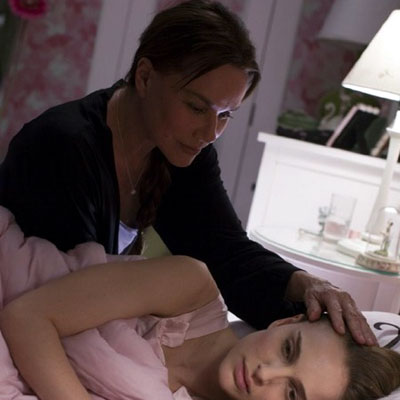
So playing with this theme, I thought it could be interesting if the roles were reversed, and we could do a story about how an overprotective mother is experiencing a hard time dealing with her daughter's new boyfriend, and how she feels that he is corrupting her, and planning to sabotage her life. The mother then starts hallucinating scenes of him trying to kill her, and ends up killing the boy in the end.
This overprotective mother stereotype has also been used in a few films, for example in Black Swan.

The opening sequence:
- Close ups of the mother in the kitchen chopping vegetables, with a very sharp, large knife.
- We can hear a girl's laughter and squeals from upstairs, along with muffled sounds of the boyfriend's speech.
- The mother carries on cutting the food with large, forced motions, looking incredibly angry and frustrated.
- The boy and girl walk down the stairs hand in hand, and we see her kiss him goodbye, and he leaves the house.
- Daughter walks into the kitchen to see her mum cooking, and they start talking.
- They have a conversation on something to do with how her grades seem to have fallen since she has met him, or how the mother is disapproving of how her time is spent more on going out than work.
- Daughter walks out of the kitchen to her room, looking annoyed with her mum.
- Mum is left in the kitchen looking out to the doorway, grasping her knife more tightly.
- She looks over to see that her daughters phone is left on the table and the caller ID shows a photo of him and her together, slams the knife onto the chopping board, and screen cuts to black with titles.
Thursday, 27 January 2011
Genre Research: Psychological Thriller
Here is a synopsis of thrillers, courtesy of www.filmsite.org:
These are types of films known to promote intense excitement, suspense, a high level of anticipation, ultra-heightened expectation, uncertainty, anxiety, and nerve-wracking tension. Thriller and suspense films are virtually synonymous and interchangeable categorizations, with similar characteristics and features.
If the genre is to be defined strictly, a genuine thriller is a film that rentlessly pursues a single-minded goal - to provide thrills and keep the audience cliff-hanging at the 'edge of their seats' as the plot builds towards a climax. The tension usually arises when the main character(s) is placed in a menacing situation or mystery, or an escape or dangerous mission from which escape seems impossible. Life itself is threatened, usually because the principal character is unsuspecting or unknowingly involved in a dangerous or potentially deadly situation. Plots of thrillers involve characters which come into conflict with each other or with outside forces.
Suspense-thrillers come in all shapes and forms: there are murder mysteries, private eye tales, chase thrillers, women-in-danger films, courtroom and legal thrillers, erotic thrillers, surreal cult-film soap operas, and atmospheric, plot-twisting psychodramas.
'Best Psychological Thriller Movies' by skoknicglumac on IMDB:
http://www.imdb.com/list/mo5IG2eK5DA/

Thursday, 21 October 2010
Preliminary Task
1. Who did you work with and how did you manage the task between you?


- A video camera
- A microphone
- Headphones
- Tripod
We used the video camera to video all the footage, and had it on the tripod for the whole time, to ensure that our shots were straight and stable. When using the video camera, we would press the 'record' button and then the director would call out 'camera rolling'. The assistant with the clapper board would then say the scene, the scene would then roll on for a bit, and the director would then say 'action!' After the scene is finished, we would let the scene roll on for a few seconds again, and then the director would shout 'cut!'. We left seconds to roll before and after the scene to ensure that in editing, we wouldn't cut anything off by mistake.


6. What have you learnt from completing this task? Looking ahead, how will this learning be significant when completing the rest of your foundation coursework, do you think?
From this task, I have definately learnt the rules of continuity, and the significance and importance of continuity in film. The rules of continuity such as match on action, shot order, 180 degree rule and shot/reverse shot are very important, and are needed to be taken into account when filming, as you need to know where and how to position the camera and the rest of the equipment. I have learnt that the best way of filming is to film the whole scene various times; this way you can make sure that scenes will definately flow onto eachother when editting, as you can cut as much as you like off.
I have also learnt that a shooting schedule and shot order is also very important, especially when time is a limiting factor. For example, the best way for us to shoot was shooting the inside of the classroom first, and the corridoor afterwards.
I also learnt how to use different pieces of technology, especially the microphone, and all the settings. This task was also the first time we connected a headphone to the video camera, so I have also learnt how to use the headphones.
So I think that this information I have learnt will be really helpful with the rest of my foundation coursework, especially when filming our own opening sequence. So when I film my opening sequence, I will know exactly how to use all the equipment, and I will take everything I have learnt into account, especially continuity rules and the various film theories.
Thursday, 14 October 2010
Barthe's Theory
The Butterfly Effect (2004)
1. Identify the key actions within the opening - what kinds of actions are included and how is the narrative moved forward?
At the very beginning of the movie, we see Evan (played by Ashton Kutcher) run in to what looks like an office in the dark, move the tables and chairs to block the door, and hide under the table. We see him picking up a notepad and quickly write on it; writing '...I might be able to save her.' This helps the narrative to move forward, as we understand that he wants to try and save 'her', who we guess is someone he loves. Also, as we see that he is writing onto a notepad, this is really important too - as he needs to write things down to travel back in time, which we see later on in the film.
After this scene, we see the opening credits, and we then flip back to 13 years earlier. We learn that Evan has quite a close relationship with his mother, but barely ever sees his father. (At the end of this clip we realise that he has never actually seen his father, and his first encounter is located in his father's pyschiatric institute.)
The next few scenes show Evan at school, at home and at his friend's house, and in all three scenes, we learn that he seems to blank out and forget his actions - 'I don't remember' and 'Where am I? Where'd we all go? I was just somewhere else!'
We also see that he's slightly disturbed and has a disturbing life, although he doesn't remember anything. At school he drew a picture of him killing people, at home he picked up a knife, and at his friend's house, he found himself being filmed for child pornography.
So in these opening 10 minutes, we have seen a lot of Evan's past and we can learn a lot about him, and this helps the story of the film move forward.
2. Identify the enigma codes within the opening - what kinds of questions are posed and how is the audience meant to read these codes?
As explained in question one, there are many things that happen in the opening sequence, especially in Evan's past. We find ourseleves as the audience asking 'What happened to him, why couldn't he remember anything he did?' as well as 'Why did he draw a picture of himself killing people, and why did he suddenly hold a knife when he was in the kitchen?'
This makes us wonder a lot about Evan and if there is something wrong with him; why does he keep doing strange things and keep forgetting about them? Does he just black out, or is someone possessing him? But even if we are unsure and slightly confused, we know that it will all be answered later on the movie.
However, it's not only Evan's past which makes us question what is going on - even the first scene when he is in present time. We're asking 'what is he doing? Is he being hunted/chased down? Why is he writing under a table, and who is 'her'?'
So as we can see, many questions and enigma codes are raised in this opening, which make it a great way of drawing the audience in and making them want to watch the rest of the film.
3. Identify key characters and think about what they represent in the opening.
The main key character in this film is Evan, and we can see that he is a troubled child, with a disturbing life. He is always find himself doing strange things, not remembering anything he has done, being abused by his friend's father and living without a father of his own. He represents the main part of the film and we follow his journey: we sympathise him, are shocked by him, and we almost want to go in to the film and help him.
Another key character we see in the opening sequence is his mother. She helped to bring Evan up on her own - her husband/his father is staying at a pyschiatric ward - and she loves and is terribly worried for her son. We can see she is a loving mother and is trying to help him, by bringing him to get his brain checked and bringing him to see his father, but we can also see she seems a bit helpless, and this is shown by her crying in the car, and asking for help.
4. Interpret the cultural codes in the opening. What kind of knowledge is being drawn on? social/historical/political/art and culture etc. Highlight the 3 most important references in the opening that help with audience understanding.
The film starts with a quote saying 'It has been said that something as small as the flutter of a butterfly's wing can ultimately cause a typhoon halfway around the world.' This immediately shows the audience that the film is about small changes and how this effects fate, and this is reinforced by the saying 'the butterfly effect', which is the title of the film.
There are also very obvious settings in the film, meaning they don't have to say where they are, but because we are familiar with the settings, we know exactly where they are. For example, at the very beginning of the film, we don't need a close up on a sign saying 'OFFICE'; we know where he is because of the tables, water dispenser and files. And also, in the past when Evan's mum drops him off to school, it doesn't show the name of the school or anything, but we can tell it is a school just by the shape and structure of the building, and the ring of the bell.
5. Identify key themes and analyse how they are presented visually/technically.
The key themes in the opening sequence would be enigma and the unknowing, as the characters in the film, as well as us, are wondering what is going on. This is presented by Evan's mysterious actions and how he has gotten to where he is, as he doesn't ever remember anything.
There is also a theme of sin/crime, as when he does these mysterious actions, there is always a knife and killing involved, and when he found himself at his friend's house naked, we see that their dad is filming them.
Finally, there is also a theme of fear and worry, and this is mostly represented by Evan's mother, as well as Evan's teacher and doctor, when they all worry for Evan's mental health and stability.
Saturday, 9 October 2010
Continuity in Film

In the Land of Women (2007) (scene starts from 0:04, ends at 3:04)
The scene starts with a close up of the headlights of a car, and we can see that it is parking and coming to a halt. Immediately we know that they have drove at night to some sort of field, as we can see the grass in the background. The camera zooms slightly out and then pans upwards, so that we can see Carter (Adam Brody's character) exit the car. We then have a VLS pan of Carter and the scenery behind him - this is our establishing shot, as it establishes where the scene has taken place. From what we can see, we guess they have driven to their school, as we can see a very school-like building in the background, and on the field there are white painted football lines. While this pan is taking place, we can hear our other character (Lucy, played by Kristen Stewart) get out of the car, and she is only seen in the next shot.
We then have a two shot of both our characters; Carter is bending down and Lucy is behind. This is our Master Shot, and the dialogue between them begins.
At 0:48, Carter gets up and walks towards Lucy, while the camera zooms and pans along. The fact that the scene starts with VLSs and slowly gets closer to a LS shows the continuity and follows the rule of short order. When he sits down we get a MS of him, and as the dialogue continues, the camera gets into a sequence of OTS shots.
The first OTS shot (1:06) is slightly further out and a MLS, and we can see Lucy's whole body. The next is of Carter (1:17), and we can see from his chest upwards, as it is a MS. Then the camera shows Lucy again, but this time we have a CU of just her face. So again, just by viewing these three shots, we can see that the scene is following the rule of short order, and slowly zooming in.
This carries on till about 1:34, when Lucy gets up, and we see the camera start to slowly zoom out again. And now that Lucy is standing up and Carter is sitting down, there is a large height difference, so the eyeline match rule is obviously seen. When she is talking (1:40) she has to look down, and at 1:44, he looks up to see her face. So this shot not only shows the eyeline match rule, but is also a reaction shot, as he reacts to what she has said and looks up.
The next minute of this scene carries on with more OTS/POV shots as the conversation between the two characters continue, with the shots zooming in and out again, the furthest out being the LS of Carter at 2:23.
