For our first shoot, I will need to bring:
- My iPad (for Ava's mother to use to communicate with)
- My iPod Touch and headphones (for actors to use for the bus stop scene)
- The group's tripod (for any shots that require a tripod)
- The group's clapperboard (to start each scene and make it easier for us to capture the scenes)
- Props to dress Robbie's room (to make it look more like Ava's room)
Saturday, 12 February 2011
Preparation for our first shoot
Wednesday, 2 February 2011
Genre Research: Action and Drama
As we changed our genre to Action/Drama, I then did some research on each:
Here is a synopsis of action films and drama films, courtesy of www.filmsite.org:
Action films
This major genre type includes films that have tremendous impact, continuous high energy, lots of physical stunts and activity, possibly extended chase scenes, races, rescues, battles, martial arts, mountains and mountaineering, destructive disasters (floods, explosions, natural disasters, fires, etc.), fights, escapes, non-stop motion, spectacular rhythm and pacing, and adventurous heroes - all designed for pure audience escapism with the action sequences at the core of the film.
Action films and adventure films have tremendous cross-over potential as film genres, and road films often overlap with action films. Both types of films come in a variety of forms or genre-hybrids: sci-fi or space, thrillers, crime-drama, war, horror, westerns, etc. Oftentimes, action films are great box-office hits, but lack critical appeal because of their two-dimensional heroes or villains.
Dramas
Drama Films are serious presentations or stories with settings or life situations that portray realistic characters in conflict with either themselves, others, or forces of nature. A dramatic film shows us human beings at their best, their worst, and everything in-between. Each of the types of subject-matter themes have various kinds of dramatic plots. Dramatic films are probably the largest film genre because they include a broad spectrum of films.
Dramatic themes often include current issues, societal ills, and problems, concerns or injustices, such as political unrest, class divisions, mental illness, corrupt societal institutions, or other explosive issues of the times. These films have successfully drawn attention to the issues by taking advantage of the topical interest of the subject.
The top 10 Action Films and Top 10 Dramas, courtesy of IMDB:


Friday, 28 January 2011
Initial Idea for our coursework project
As a group, we decided in our first meeting that we wanted to do a psychological thriller, and it was our jobs individually to come up with our own ideas to fit in that genre, so we could brainstorm ideas in our next meeting.
After thinking about a few psychological films I had watched in the past that I had really enjoyed, I thought of the two films in particular: The Uninvited, and The Stepfather.
Both films have a similar plotline with the fact that they are about a teenager experiencing a hard time adjusting to their parents' new partners, and how they think that the are out to kill them.
So playing with this theme, I thought it could be interesting if the roles were reversed, and we could do a story about how an overprotective mother is experiencing a hard time dealing with her daughter's new boyfriend, and how she feels that he is corrupting her, and planning to sabotage her life. The mother then starts hallucinating scenes of him trying to kill her, and ends up killing the boy in the end.
This overprotective mother stereotype has also been used in a few films, for example in Black Swan.

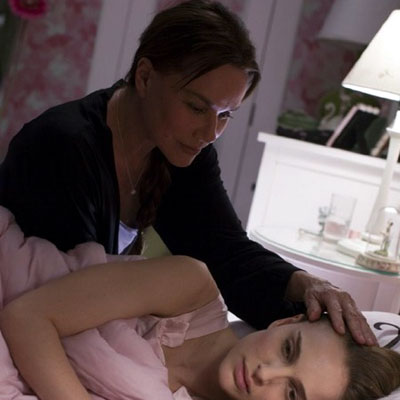
The opening sequence:
- Close ups of the mother in the kitchen chopping vegetables, with a very sharp, large knife.
- We can hear a girl's laughter and squeals from upstairs, along with muffled sounds of the boyfriend's speech.
- The mother carries on cutting the food with large, forced motions, looking incredibly angry and frustrated.
- The boy and girl walk down the stairs hand in hand, and we see her kiss him goodbye, and he leaves the house.
- Daughter walks into the kitchen to see her mum cooking, and they start talking.
- They have a conversation on something to do with how her grades seem to have fallen since she has met him, or how the mother is disapproving of how her time is spent more on going out than work.
- Daughter walks out of the kitchen to her room, looking annoyed with her mum.
- Mum is left in the kitchen looking out to the doorway, grasping her knife more tightly.
- She looks over to see that her daughters phone is left on the table and the caller ID shows a photo of him and her together, slams the knife onto the chopping board, and screen cuts to black with titles.
Thursday, 27 January 2011
Genre Research: Psychological Thriller
Here is a synopsis of thrillers, courtesy of www.filmsite.org:
These are types of films known to promote intense excitement, suspense, a high level of anticipation, ultra-heightened expectation, uncertainty, anxiety, and nerve-wracking tension. Thriller and suspense films are virtually synonymous and interchangeable categorizations, with similar characteristics and features.
If the genre is to be defined strictly, a genuine thriller is a film that rentlessly pursues a single-minded goal - to provide thrills and keep the audience cliff-hanging at the 'edge of their seats' as the plot builds towards a climax. The tension usually arises when the main character(s) is placed in a menacing situation or mystery, or an escape or dangerous mission from which escape seems impossible. Life itself is threatened, usually because the principal character is unsuspecting or unknowingly involved in a dangerous or potentially deadly situation. Plots of thrillers involve characters which come into conflict with each other or with outside forces.
Suspense-thrillers come in all shapes and forms: there are murder mysteries, private eye tales, chase thrillers, women-in-danger films, courtroom and legal thrillers, erotic thrillers, surreal cult-film soap operas, and atmospheric, plot-twisting psychodramas.
'Best Psychological Thriller Movies' by skoknicglumac on IMDB:
http://www.imdb.com/list/mo5IG2eK5DA/

Thursday, 21 October 2010
Preliminary Task
1. Who did you work with and how did you manage the task between you?
I worked in a group of four, with Robbie, Jessica Rich and Eva. We managed the tasks between us evenly, with Robbie and Eva predominantly acting, and Jess and I predominantly filming. Jess and I filmed all the two shots and the master shot, and Robbie and Eva filmed the parts that they could: the scenes which they weren't in screen. While Jess filmed, I checked the sound, and vice versa, and Robbie and Eva had a go with the sound too.
When editting, we each took it in turns to capture and cut too, and as a group, decided when to cut to the next scenes, to make sure our film flowed seamlessly.

2. How did you plan your sequence? What processes did you use? What theories did you try and take into account?
We planned our sequence by having a meeting during a private study. We discussed a few ideas, and once we had our main idea of what we were doing, we storyboarded. As we were drawing the storyboard, we discussed all the different shot types, and made sure that they followed the continuity rules, e.g. the 180 degree rule and short order.


After we drew out our whole storyboard, we then wrote out our script, and then wrote out all the shots that we would need to be filmed. Then, we discussed how we should shoot the scenes, and in which order, to make it the most time efficient and easy. We started with the master shot, and then shot all the different scenes inside the room, and finally, all the scenes outside in the corridoor.
We took in quite a few theories into account, the main being continuity, especially the 180 degree rule, shot/reverse shot, and match on action.
We also took in a few film theories, for example Levi Strauss's theory of binary opposites, with our opposites such as boy/girl, dealer/buyer...etc, and Barthe's theory of the enigma code, with the audience thinking 'What is he buying? Drugs?' before the banana is shown.
We used a lot of technology in this task, as we had to film our scene, and then edit it.
During filming, we used:
- A video camera
- A microphone
- Headphones
- Tripod
We used the video camera to video all the footage, and had it on the tripod for the whole time, to ensure that our shots were straight and stable. When using the video camera, we would press the 'record' button and then the director would call out 'camera rolling'. The assistant with the clapper board would then say the scene, the scene would then roll on for a bit, and the director would then say 'action!' After the scene is finished, we would let the scene roll on for a few seconds again, and then the director would shout 'cut!'. We left seconds to roll before and after the scene to ensure that in editing, we wouldn't cut anything off by mistake.
- A video camera
- A microphone
- Headphones
- Tripod
We used the video camera to video all the footage, and had it on the tripod for the whole time, to ensure that our shots were straight and stable. When using the video camera, we would press the 'record' button and then the director would call out 'camera rolling'. The assistant with the clapper board would then say the scene, the scene would then roll on for a bit, and the director would then say 'action!' After the scene is finished, we would let the scene roll on for a few seconds again, and then the director would shout 'cut!'. We left seconds to roll before and after the scene to ensure that in editing, we wouldn't cut anything off by mistake.
As our scenes also had dialogue, we attached a microphone to the top of the video camera, and plugged in a set of headphones too. So while the director was filming the scene, the assistant would wear the headphones, and make sure that they could hear all the dialogue. To make it easier for the dialogue to be heard and the background noise to be minimalised, we set the microphone to shotgun, and faced it towards the actors.
Finally, after shooting, we then had to edit our footage. We used the computers in the edit suite, and plugged our video cameras straight into the computer via the firewire. This meant that our video could be viewed - and therefore editted - on the computer. So to do so, we used the programme Adobe Premiere. There we could easily capture all the scenes, and this was easy to do as we used the clapperboard before each shot, so we knew what each shot was. After capturing all our different shots, we then cut them down to size, and then put them in order onto are timeline, using the two tracks diagonally and alternatively.

4. What factors did you have to take into account when planning, shooting and editing?
The first factor we had to take into account was time. We were only allowed an hour to shoot and an hour to edit, meaning that we shouldn't be too creative, and just keep it simple. We also had to take in account the room we were filming in, and make sure that it had everything we needed: in our case, just a door, a table and two chairs.
So when planning and storyboarding, we had to make sure what we were drawing was possible and practical, with the props we needed in the scene, as well as the actors being able to act.
While storyboarding we also took all the continuity rules into account; after all, our scene had to flow seamlessly and illustrate continuity. So we made sure we followed the rules such as the 180 degree rule and shot order, so our scene would look normal, and our viewers wouldn't get confused.
When shooting, we took the room and the props into account, and had to keep making sure that it looked right. For example, in one scene there was a computer in the background, but we thought it looked quite distracting and weird with just one computer there, so we ended up moving it out of the shot. And again, we also took the continuity rules in mind, for example, we made sure that the actors looked up at the right time, used the same hand for the exchange of the money and banana, and turned the same page of the book with the same hand.
Finally, during editting, we again kept the continuity rules in mind, and made sure our scene flowed seamlessly. When cutting two shots and putting them together, we made sure that they followed the rule 'match on action', with the last second in the first shot being exactly the same as the first second in the second shot. We also tried to make the colour and lighting in all the shots the same, so one or two shots in the scene didn't suddenly look out of place. This was demonstrated with the second BCU, of Eva looking up. Somehow when we filmed it, the shot was really bright and slightly tainted yellow, so when editting, we altered the brightness and contrast, to make it look similar to all the other shots.
5. How successful was your sequence? Please identify what worked well, and with hindsight, what would you improve/do differently?
In my opinion, I think our sequence worked really well, as almost all of shots flow easily and seamlessly to the next, 'suspending the audience's disbelief'. All the shots are filmed with a high quality, with none of the shots showing a jolt in the camera or anything, making it easy on the viewers' eye. The sound works well in the scene too, with all the dialogue easily being able to be heard, in contrast to the solemn silence which is in most of the scene.
The predominant silence gives the scene a sombre, serious mood, which ties in with the 'drug dealing' theme, and adds to the humour when instead of drugs, a banana is shown in screen. The addition of the line 'Full of potassium' also makes the scene funnier, as that is not what you would expect from a usual drug deal, and is in actual fact, true!


6. What have you learnt from completing this task? Looking ahead, how will this learning be significant when completing the rest of your foundation coursework, do you think?
From this task, I have definately learnt the rules of continuity, and the significance and importance of continuity in film. The rules of continuity such as match on action, shot order, 180 degree rule and shot/reverse shot are very important, and are needed to be taken into account when filming, as you need to know where and how to position the camera and the rest of the equipment. I have learnt that the best way of filming is to film the whole scene various times; this way you can make sure that scenes will definately flow onto eachother when editting, as you can cut as much as you like off.
I have also learnt that a shooting schedule and shot order is also very important, especially when time is a limiting factor. For example, the best way for us to shoot was shooting the inside of the classroom first, and the corridoor afterwards.
I also learnt how to use different pieces of technology, especially the microphone, and all the settings. This task was also the first time we connected a headphone to the video camera, so I have also learnt how to use the headphones.
So I think that this information I have learnt will be really helpful with the rest of my foundation coursework, especially when filming our own opening sequence. So when I film my opening sequence, I will know exactly how to use all the equipment, and I will take everything I have learnt into account, especially continuity rules and the various film theories.
Thursday, 14 October 2010
Barthe's Theory
The Butterfly Effect (2004)
1. Identify the key actions within the opening - what kinds of actions are included and how is the narrative moved forward?
At the very beginning of the movie, we see Evan (played by Ashton Kutcher) run in to what looks like an office in the dark, move the tables and chairs to block the door, and hide under the table. We see him picking up a notepad and quickly write on it; writing '...I might be able to save her.' This helps the narrative to move forward, as we understand that he wants to try and save 'her', who we guess is someone he loves. Also, as we see that he is writing onto a notepad, this is really important too - as he needs to write things down to travel back in time, which we see later on in the film.
After this scene, we see the opening credits, and we then flip back to 13 years earlier. We learn that Evan has quite a close relationship with his mother, but barely ever sees his father. (At the end of this clip we realise that he has never actually seen his father, and his first encounter is located in his father's pyschiatric institute.)
The next few scenes show Evan at school, at home and at his friend's house, and in all three scenes, we learn that he seems to blank out and forget his actions - 'I don't remember' and 'Where am I? Where'd we all go? I was just somewhere else!'
We also see that he's slightly disturbed and has a disturbing life, although he doesn't remember anything. At school he drew a picture of him killing people, at home he picked up a knife, and at his friend's house, he found himself being filmed for child pornography.
So in these opening 10 minutes, we have seen a lot of Evan's past and we can learn a lot about him, and this helps the story of the film move forward.
2. Identify the enigma codes within the opening - what kinds of questions are posed and how is the audience meant to read these codes?
As explained in question one, there are many things that happen in the opening sequence, especially in Evan's past. We find ourseleves as the audience asking 'What happened to him, why couldn't he remember anything he did?' as well as 'Why did he draw a picture of himself killing people, and why did he suddenly hold a knife when he was in the kitchen?'
This makes us wonder a lot about Evan and if there is something wrong with him; why does he keep doing strange things and keep forgetting about them? Does he just black out, or is someone possessing him? But even if we are unsure and slightly confused, we know that it will all be answered later on the movie.
However, it's not only Evan's past which makes us question what is going on - even the first scene when he is in present time. We're asking 'what is he doing? Is he being hunted/chased down? Why is he writing under a table, and who is 'her'?'
So as we can see, many questions and enigma codes are raised in this opening, which make it a great way of drawing the audience in and making them want to watch the rest of the film.
3. Identify key characters and think about what they represent in the opening.
The main key character in this film is Evan, and we can see that he is a troubled child, with a disturbing life. He is always find himself doing strange things, not remembering anything he has done, being abused by his friend's father and living without a father of his own. He represents the main part of the film and we follow his journey: we sympathise him, are shocked by him, and we almost want to go in to the film and help him.
Another key character we see in the opening sequence is his mother. She helped to bring Evan up on her own - her husband/his father is staying at a pyschiatric ward - and she loves and is terribly worried for her son. We can see she is a loving mother and is trying to help him, by bringing him to get his brain checked and bringing him to see his father, but we can also see she seems a bit helpless, and this is shown by her crying in the car, and asking for help.
4. Interpret the cultural codes in the opening. What kind of knowledge is being drawn on? social/historical/political/art and culture etc. Highlight the 3 most important references in the opening that help with audience understanding.
The film starts with a quote saying 'It has been said that something as small as the flutter of a butterfly's wing can ultimately cause a typhoon halfway around the world.' This immediately shows the audience that the film is about small changes and how this effects fate, and this is reinforced by the saying 'the butterfly effect', which is the title of the film.
There are also very obvious settings in the film, meaning they don't have to say where they are, but because we are familiar with the settings, we know exactly where they are. For example, at the very beginning of the film, we don't need a close up on a sign saying 'OFFICE'; we know where he is because of the tables, water dispenser and files. And also, in the past when Evan's mum drops him off to school, it doesn't show the name of the school or anything, but we can tell it is a school just by the shape and structure of the building, and the ring of the bell.
5. Identify key themes and analyse how they are presented visually/technically.
The key themes in the opening sequence would be enigma and the unknowing, as the characters in the film, as well as us, are wondering what is going on. This is presented by Evan's mysterious actions and how he has gotten to where he is, as he doesn't ever remember anything.
There is also a theme of sin/crime, as when he does these mysterious actions, there is always a knife and killing involved, and when he found himself at his friend's house naked, we see that their dad is filming them.
Finally, there is also a theme of fear and worry, and this is mostly represented by Evan's mother, as well as Evan's teacher and doctor, when they all worry for Evan's mental health and stability.
Saturday, 9 October 2010
Continuity in Film

In the Land of Women (2007) (scene starts from 0:04, ends at 3:04)
The scene starts with a close up of the headlights of a car, and we can see that it is parking and coming to a halt. Immediately we know that they have drove at night to some sort of field, as we can see the grass in the background. The camera zooms slightly out and then pans upwards, so that we can see Carter (Adam Brody's character) exit the car. We then have a VLS pan of Carter and the scenery behind him - this is our establishing shot, as it establishes where the scene has taken place. From what we can see, we guess they have driven to their school, as we can see a very school-like building in the background, and on the field there are white painted football lines. While this pan is taking place, we can hear our other character (Lucy, played by Kristen Stewart) get out of the car, and she is only seen in the next shot.
We then have a two shot of both our characters; Carter is bending down and Lucy is behind. This is our Master Shot, and the dialogue between them begins.
At 0:48, Carter gets up and walks towards Lucy, while the camera zooms and pans along. The fact that the scene starts with VLSs and slowly gets closer to a LS shows the continuity and follows the rule of short order. When he sits down we get a MS of him, and as the dialogue continues, the camera gets into a sequence of OTS shots.
The first OTS shot (1:06) is slightly further out and a MLS, and we can see Lucy's whole body. The next is of Carter (1:17), and we can see from his chest upwards, as it is a MS. Then the camera shows Lucy again, but this time we have a CU of just her face. So again, just by viewing these three shots, we can see that the scene is following the rule of short order, and slowly zooming in.
This carries on till about 1:34, when Lucy gets up, and we see the camera start to slowly zoom out again. And now that Lucy is standing up and Carter is sitting down, there is a large height difference, so the eyeline match rule is obviously seen. When she is talking (1:40) she has to look down, and at 1:44, he looks up to see her face. So this shot not only shows the eyeline match rule, but is also a reaction shot, as he reacts to what she has said and looks up.
The next minute of this scene carries on with more OTS/POV shots as the conversation between the two characters continue, with the shots zooming in and out again, the furthest out being the LS of Carter at 2:23.
Subscribe to:
Posts (Atom)
